
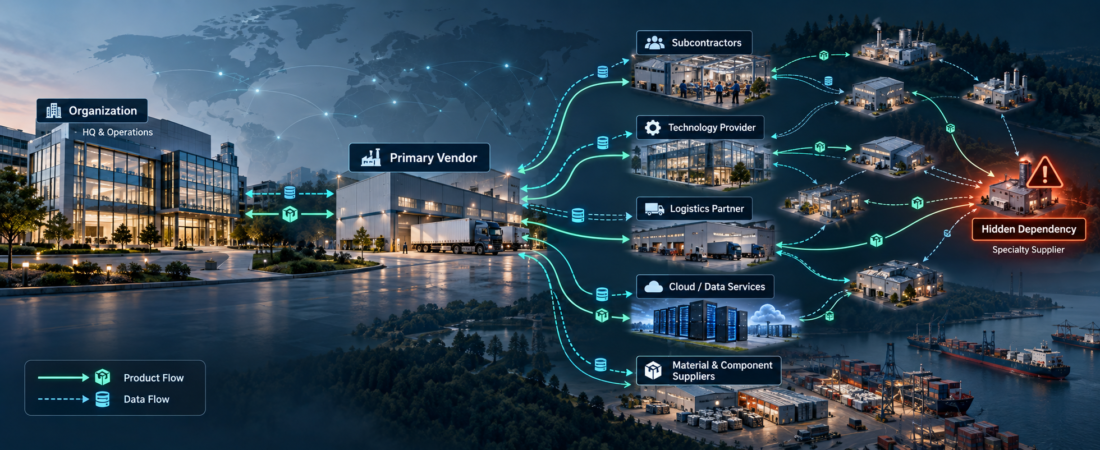
You choose a vendor after careful review. The team is responsive. The agreement looks reasonable. References are strong. Then the service fails because a company you’ve never heard of had an outage.
You didn’t select that company. Your customer doesn’t care.
Organizations rarely operate through simple one-to-one vendor relationships. A payroll provider uses a hosting platform. A software platform relies on an identity service. A managed service provider depends on subcontractors, data centers, telecommunications carriers, and specialized tools. Your vendor’s vendor may depend on another vendor.
The service chain can become long before anyone inside your organization sees it.
Know, Like, Trust — But Verify.
Trust matters in business. It just can’t replace evidence when another organization can affect your customers, data, revenue, compliance, or reputation.
Verification begins with understanding what the vendor actually supports. “Critical vendor” is too broad to guide a decision. Which business service depends on the vendor? What information can it access? What work stops if it fails? How long can the organization tolerate the interruption? What alternative exists?
Then look beyond the first contract. Ask which material third parties help deliver the service. You don’t need a directory of every office-supply company in the chain. You need visibility into dependencies capable of changing the outcome.
Contracts should support that visibility. Notification requirements, service commitments, incident responsibilities, data handling, audit rights, termination assistance, and subcontractor obligations aren’t legal decorations. They’re operating controls. The language matters because it defines what happens when goodwill meets pressure.
Verification also has a life after selection. A vendor can be strong on the day of review and weak eighteen months later. Ownership changes. Key people leave. Services move. Financial pressure grows. A new subcontractor enters the chain. The review cadence should reflect the consequence of failure, not the convenience of the calendar.
This doesn’t mean treating every vendor as an adversary. The best vendor relationships improve when both sides understand the dependency, the evidence, and the expectation. Mature oversight gives a capable vendor the chance to address a concern before it becomes a dispute.
It also prepares the organization for failure without pretending failure can be eliminated. Who receives the alert? Who decides whether to invoke an alternative? How will customers be informed? Where is the data? What access must be removed at the end of the relationship?
If the answer is “the vendor handles that,” keep asking. Outsourcing the work doesn’t outsource your accountability to the customer.
Choose one service your organization can’t operate without. Trace the organizations required to deliver it. The names you didn’t know are where the next useful questions begin.
Wentworth Consulting Group, LLC helps organizations make critical vendor dependencies, evidence, ownership, and response decisions visible before a hidden link becomes a public failure.