
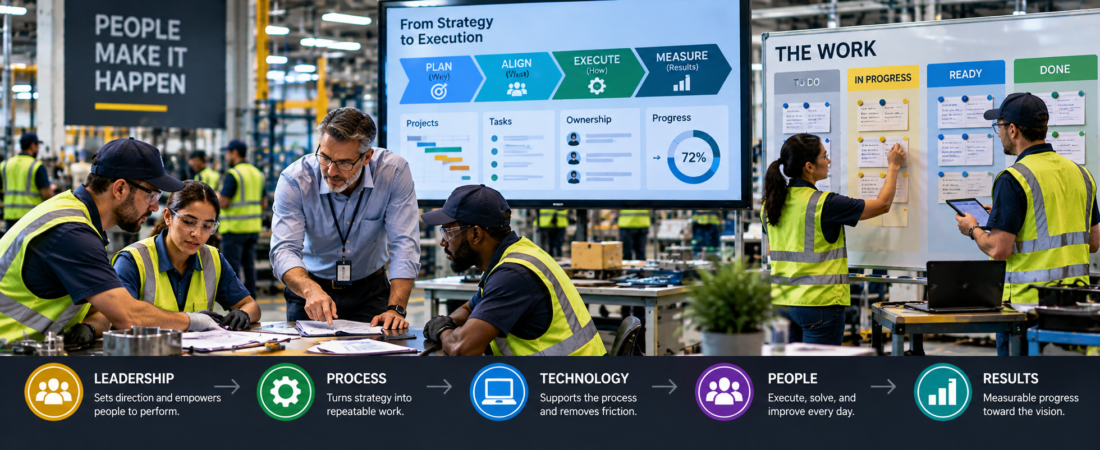
Technology projects are often introduced with transformative language.
The new platform will create visibility. The automation will improve efficiency. The dashboard will strengthen accountability. The collaboration tool will connect the organization.
Then the team signs the contract, completes the configuration, and continues the old behavior.
Leaders ask for reports outside the system. Employees maintain parallel spreadsheets because executives do. Approvals still happen in private messages. Teams treat required fields as optional when a senior person is in a hurry. Six months later, leadership asks why adoption is low.
The answer may be standing at the front of the room.
Technology does not transform organizations. Disciplined technology leadership does.
Employees learn the real priority by watching what leaders use, tolerate, and bypass. If the executive team treats the new system as an administrative requirement for everyone else, the organization will do the same. If leaders make decisions from its data, require work to move through the defined process, and correct exceptions consistently, the system becomes part of the operation.
This isn’t about performative enthusiasm for software. Leadership adoption begins before selection.
Leaders must be clear about the business problem. A vague goal such as “improve collaboration” can’t govern design. Which collaboration is failing? Where’s the delay, duplication, risk, or customer harm? What should be measurably different after implementation?
They must also accept process decisions. Technology can’t fix a disagreement about ownership. It can route an approval, but someone still has to decide who owns it, what authority they have, and what happens when the deadline is missed.
Leaders must protect the implementation from casual exceptions. Every “just this once” workaround teaches the organization where the system is optional. Some exceptions are legitimate, but legitimate exceptions should be visible, approved, and learned from.
Finally, leaders must evaluate value after launch. Go-live is not a business outcome. Usage isn’t automatically value. The question is whether the technology improved the operating result it was selected to change.
Good technology leadership also knows when not to buy. A new tool creates another vendor, contract, data flow, security surface, training requirement, and place for truth to fragment. Sometimes the mature decision is to simplify the process inside the systems already owned.
The next time a technology initiative is described as transformative, ask what leadership behavior must change for the promise to become true. If the answer is “none,” it probably isn’t a transformation. It’s a purchase.
Wentworth Consulting Group, LLC helps organizations connect technology decisions to operating outcomes, leadership behavior, adoption, and governance so the investment can produce what the proposal promised.